Strategy ·
Snowball vs. Avalanche: The Brutal Truth About Paying Off Debt
Compare psychological dopamine vs. mathematical efficiency. Discover how to choose the right strategy or build a hybrid battle plan.
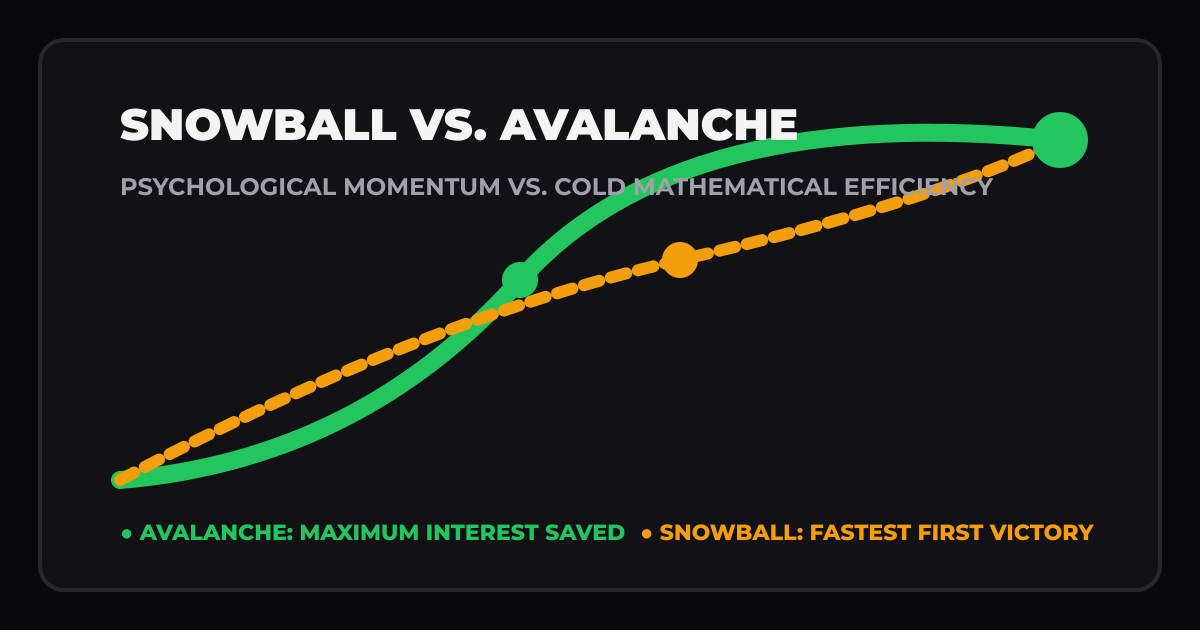
The Great Debate: Dopamine vs. Mathematics
Personal finance commentators love holy wars. For decades, spreadsheet purists have screamed that the Debt Avalanche is the only rational method, while behavioral coaches insist the Debt Snowball is the only way real humans survive the grind.
Here is the unfiltered truth: Both sides are right, and both sides are dangerously incomplete.
If you pick the mathematically optimal strategy but abandon it six months in because you feel like you are digging a tunnel with a teaspoon, you lose. Conversely, if you prioritize quick psychological wins while letting a 29% APR store credit card compound unchecked, you are setting thousands of dollars on fire for emotional comfort.
1. The Debt Snowball: Velocity & Psychological Wins
The Debt Snowball ranks your non-mortgage debts from smallest balance to largest balance, ignoring interest rates entirely.
You pay minimum payments across every liability except the smallest one. Every available dollar of surplus cash flow is hurled at that tiny balance until it hits zero. Once eliminated, you roll the entire minimum payment plus your surplus into the next smallest balance.
Why It Works
Human beings are not calculators. We run on dopamine, momentum, and visible victories. When you eliminate a small $450 medical bill in three weeks, your brain registers proof of concept. You went from five creditors down to four. That tangible victory keeps you from reverting to retail therapy.
The Downside
It can be expensive. If your smallest balance is a 0% medical bill and your largest balance is a $15,000 credit card at 27.99% APR, ignoring the credit card for eighteen months can cost you thousands of dollars in extra interest fees.
2. The Debt Avalanche: Mathematical Cold War
The Debt Avalanche ranks your debts strictly from highest APR to lowest APR, ignoring account balances.
You pay minimums on everything while funneling every spare cent toward the account charging the highest percentage interest. Once that shark is slain, you move to the second highest APR.
Why It Works
It is mathematically unassailable. By targeting the most aggressive interest rates first, you minimize the total dollars surrendered to bank executives. On a multi-year payoff sprint, the Avalanche frequently saves between $1,500 and $8,000 in raw interest compared to the Snowball.
The Downside
The “Desert of Despair.” If your highest APR debt happens to be a $22,000 consolidated personal loan, you might throw $600 a month at it for two full years without crossing off a single account. Many people burn out during this phase and surrender.
3. The Short-Term Pain Hybrid Protocol
You do not have to pledge blind allegiance to either camp. Many of the fastest debt eliminations we have observed use a Tactical Hybrid Protocol:
- Score One Fast Knockout: If you have an annoying balance under $1,000 (a retail store card, an old dental bill, or a collection notice), destroy it immediately regardless of rate. Get the psychological boost and delete one bill from your mailbox.
- Pivot to High-Interest Predators: Once that quick win is secured, switch immediately to Avalanche mode. Direct your combined firepower at everything above 18% APR. High-interest revolving credit is an emergency; treat it like one.
- Finish with Momentum: Once credit cards and high-rate loans are eradicated and you are left with lower-rate liabilities (like sub-6% student loans or auto notes), finish them using whichever order maintains your personal discipline.
Run Your Personal Numbers
Do not guess which approach fits your situation. You can run your exact debt portfolio through our interactive comparison tool on the homepage or deploy our free Google Sheets tracking template:
- Use the interactive Snowball vs. Avalanche Battle Engine to see your interest differential to the penny.
- Download The Debt Elimination Battle Map to track weekly balance drops directly in Google Drive.